Friday, May 20, 2011

Preparing for Re-Entry: Reflecting on How You’ve Changed


“I love to see a young girl go out and grab the world by the lapels. Life’s a bitch. You’ve got to go out and kick ass.” – Maya Angelou
How has my study abroad experience changed me? There are so many answers to that question. One change is my level of self-confidence. This semester gave me the opportunity to see how independent I really could be.

Spending four months in Paris, you could stay in the city the entire time and still not see everything. We also enjoyed a central location in Europe, with all the surrounding countries to visit, which required making some tough decisions. We all arrived here with goals and priorities for how we wanted to spend our precious time and euros. This led to some group activities, and other times everyone splitting off in different directions.

I put my confidence to the test by learning to navigate through airports and train stations alone, sometimes in places where I did not speak the language, and figuring out how to reach my destinations. I discovered that getting lost isn’t always a bad thing. I met strangers who became friends. I came to realize that if you REALLY want to do something, you have to ‘just do it.’

Most of my travels around Europe were in the company of others, but there were a few times I found myself going it alone. One example is the Cinque Terre in Italy. I wanted to see this so badly, even if I couldn’t find anyone else who could go along. Surprisingly, it ended up being one of the highlights of my trip! It was right in the middle of two very busy, fun-filled tours with lots of people, and it gave me two days to just completely relax and recuperate.

As I prepare to return home, I am already planning future trips in my dreams! I feel confident to travel anywhere now, and I am looking forward to new adventures. I am grateful for each experience I have had, all the highs and the lows. They have prepared me to face any challenge I meet, whether it is traveling the world, or back in my everyday life at home.


Roland Garros

"Fitting that a game that stirs such passion begins with the score Love-Love"
On Tuesday this week I lived out one of my dreams and went to Roland Garros, the French Open. I started playing tennis at the age of seven, and have been in love with the sport ever since. Watching the grand slams on TV every year, my dream has always been to someday attend all four. Roland Garros is the second grand slam of the year, following the Australian Open. Next up is Wimbledon, and finally, the U.S. Open. The French Open is a unique tournament because it is played on clay courts. The clay courts are a slower playing surface than grass or hard court, which makes it more difficult for a player to hit an unreturnable shot, or what some call a “clean winner.” This, coupled with five-set men’s singles matches without a tiebreak in the final set, makes the French Open of the most physically demanding tennis tournaments in the world.
The French Open main draw officially starts on Saturday May 21st, but since I will be back in the States by then, I got tickets to the first day of the Qualifiers. It was still an awesome day of tennis; the players were amazing and made it look so easy. The crowds were also smaller, with no lines for the bathrooms or shops. I loved going on the first day because everything was ready, and the souvenir store had everything in stock. Even though the main draw hadn’t started, I was able to see France’s Richard Gasquet practice on the Susan Lenglen court. It was fun to have a chance to watch at least one of the more well-known players.
It was amazing to see such great tennis in person. I was able to watch four matches. The longest was between J. Ward from Great Britain and R. Harrison from the United States. In the beginning I was cheering for Harrison, trying to show a little national pride for a fellow American. However, I switched sides after an incident during the second set where Harrison hit a double fault and shouted at the top of his lungs “F****ing embarrassing! God!” He received a point penalty for disrespectful/rude behavior. I love that tennis is a sport of manners. This brought back memories of all the tennis brats I observed throughout my childhood tennis years. From then on I was cheering for Ward. It was very exciting because the players were so equally matched. They both really moved the ball around the court and played to their best ability, scrambling for every shot. In the end I was disappointed because Harrison, the cry baby, won, but it was wonderful to be at the French Open!

Wednesday, May 18, 2011

Normandy

"It's on the strength of observation and reflection that one finds a way. So we must dig and delve unceasingly." - Claude Monet
This weekend I went to Normandy on my last excursion with my study abroad program. It was just a day trip, so we didn’t get to see the D-Day beaches or Mont St. Michel , which I had been hoping to see before leaving France , but I still had a great time, and now I’ll have another excuse to come back!
The day started off with a trip to Monet’s house and gardens in Giverny. Claude Monet was one of the founders of French impressionist painting. He first lived at this house with his family in 1883, and bought the property in 1890. Monet transformed the house, building a greenhouse and a second studio. From the 1880s until the time of his death, Monet worked on his “series” paintings, including the famous Water Lilies, which he painted at Giverny. Monet was a master at interpreting light in his art. He loved to paint the organized nature of his garden, and he was an avid gardener, who wrote detailed instructions for his gardens with precise descriptions of how he wanted everything. Monet’s Nymphéas (Water Lilies) series consists of about 250 paintings that depict his flower garden. These are showcased in museums all over the world, including the Orangerie Museum here in Paris . My friends and I went to the Orangerie earlier this week, and we were captivated by the beauty of Monet’s work. Viewing some of his actual paintings, and then later seeing the location for their inspiration, was an amazing experience.
 Leaving Giverny, we headed to the idyllic Normandy town of Honfleur . This quaint town, with its charming port and old buildings, attracted artists such as Gustave Courbet, Eugene Boudin, Claude Monet, and Johan Jongkind to paint here. These artists formed the école de Honfleur (Honfleur school) and contributed further to the Impressionist movement of the time. Honfleur is beautiful and it was nice to spend an afternoon in the laid-back atmosphere of this harbor town. We enjoyed a lunch of very fresh, delicious seafood, and after lunch, took a walk to see Sainte-Catherine church, the largest wood church built in France . It was beautiful on the inside and I even spotted a statue of St. Anne, my middle name. France has many distinct regions with unique characteristics. I loved our visit to Normandy ; being close to the ocean and spending the afternoon in a harbor town reminded me of home

Sunday, May 15, 2011

Brussels & European Union

“At every crossroads on the path that leads to the future,
tradition has placed 10,000 men to guard the past.” - Maurice Maeterlinck
(Belgian Symbolist Poet, Playwright, and Essayist 1862-1949)
This week I went on a class field trip to Brussels, Belgium for the day, with my European Union class, to take a tour of the European Union Parliament building and see the other EU buildings in the European Quarter of Brussels. Technically, the EU has no official capital, but Brussels is home to many of the EU institutions, including the European Commission, Council of the European Union, the European Council, and it is the second seat of the European Parliament. During our visit we took a tour of the Espace Léopold, the building which houses the European Parliament.
The EU Parliament is the only directly elected body of the EU. The Parliament is made up of 736 MEPs (Member of the European Parliament) who are elected every five years by the citizens of the 27 Member States of the European Union. Parliament is the “first institution” of the EU and shares equal legislative authority with the Council, and both have equal control over the EU budget. Parliament plays an active role in drafting legislation in areas such as environmental protection, consumer rights, equal opportunities, transport, and the free movement of workers, capital, services and goods. It was fun to see where all of the action takes place.
After our visit, we walked around Brussels, ending up in the old town area at the Grand Place. This square is the most important tourist destination in Brussels. The area was first established in the 10th century by Charles, the Duke of Lower Lorraine, and by the 11th century the marketplace was established. The City Hall was built in this square in 1409, and after that came the King’s House and the many guildhalls to surround the square. The Grand Place served as a market all the way until 1959, and it has recently been voted the most beautiful square in Europe. Going to Brussels on a field trip was amazing. I visited Bruges during my spring break, but didn’t have a chance to see Brussels. It is not as quaint and idyllic as Bruges, but it was fun to experience another large European city.

Saturday, May 14, 2011

La Cuisine Paris

 “The only real stumbling block is fear of failure.
In cooking you’ve got to have a what-the-hell attitude.”  - Julia Child

This week I took a cooking class at La Cuisine Paris near L’Hotel de Ville. I have been wanting to do this all semester, and finally got around to doing it. We learned how to make three types of popular French breakfast pastries: croissants, croissant aux amande, and pain au chocolat. I’ve never taken a cooking class before, and it was fun to meet other amature cooks like myself, who are interested in learning how to cook popular French foods.
In the class we not only learned how to make the croissant dough, but how to make fillings, and also how to roll the dough with the fillings. The head chef, Jenny, told us that you can be very creative with croissant fillings. You can play around with the types of extract you use in the cream, with vanilla, orange, almond. She says it is important to be creative, and even suggested using jam if you want fruity flavor. One of her favorite ways to make croissants is to fill them with gruyere cheese and ham for a savory breakfast.
The most complicated task of the class was making the dough for the pastries. To get the end product you have to fold together two squares; one of the dough and one of BUTTER. Combining these two to get the perfectly layered dough requires a lot of rolling and folding. You also have to be careful that the butter never gets too warm. If the dough starts to spring back or you see any shiny parts of butter you have to put it in the refrigerator to cool it down before continuing on with the rolling and folding. All of this work definitely paid off, because in the end we took away some YUMMY pastries. Learning how to make French breakfast pastries with people from all over the world in a small cooking school in Paris was an amazing experience! It will be so fun to use the skills I’ve learned to cook for my friends and family back home.

Thursday, May 5, 2011

Rethinking Stereotypes & Critical Thinking

"Travel is fatal to prejudice, bigotry, and narrow-mindedness, and many of our people need it sorely on these accounts.  Broad, wholesome, charitable views of men and things cannot be acquired by vegetating in one little corner of the earth all one's lifetime."  ~Mark Twain
While studying abroad in Paris , I have been exposed to stereotypes that the French have about Americans, as well as reminders of stereotypes that Americans back home have about the French. A few days ago I met a couple of French boys near the Pantheon who told me that they had just watched the movie, American Pie, and thought that college life in America looked like one big, crazy party. Unfortunately, this stereotype of Americans is popular with the French. I tried to explain to these guys that all American students are not like those in the movies, but I’m not sure they believed me.
For many people from other countries, the only thing they know about the United States is what they have seen on TV, and the content of some of those shows makes it understandable that they might have a warped view of America . Americans traveling  abroad can either reinforce those stereotypes, or give people a different view of Americans. I hope that the French people I have met can see that there is a flip side to the American images portrayed by TV shows like the Jersey Shore and Baywatch, and movies like American Pie. I hope they can see that we are not all alcoholic bimbos with no manners, class, or brains.
On the other hand, in America there is the stereotype that the French are mean, nasty people, who hate Americans. I can honestly say that this is NOT true. I have met so many kind, nice French people. I remember discovering this almost immediately, when on my second night in Paris , while I was buying yogurt from the corner store, the man behind the counter showed me how to hold my bag and told me to always have it zipped and in front of me, as he was concerned that I would be pick-pocketed! I find that in Paris “Bonjour” and a smile go a long way. Greetings and manners are appreciated here. Sometimes when I eat at the dining hall on campus a French person will sit near me and turn to me, smile, and wish me “bon appétit!” It’s times like those when it is hard for me to imagine why anyone would accuse the French of being nasty people. I think that your experience completely depends on the attitude you bring with you.
Before coming to France , I was told a great analogy that is used to explain the difference between French and Americans by comparing them to coconuts and peaches. Americans are peaches. They are soft on the outside, easy to get to know, friendly, and hard in the center(pit), only letting a few people know their true inner selves. The French are coconuts. They are hard on the outside, and sometimes can seem rude or brief with strangers, but they are incredibly soft on the inside. Once they make a friend they are extremely loyal and remain friends for life. In America we tend to have more surface-level friends than very close friends. When a coconut and a peach bump into each other the peach gets bruised and gets its feelings hurt, while the coconut moves on as if nothing important has happened. So there are differences between French and American people, but they are not so severe that they cannot be overcome. I like to remind myself to look for the good in people, an early lesson learned in childhood from the movie, Pollyanna:

“When you look for the bad in mankind, expecting to find it, you surely will.”
- Abraham Lincoln

Monday, May 2, 2011

Santé!

"After one taste of French food ... I was hooked. I'd never eaten like that before, I didn't know such food existed. The wonderful attention paid to each detail of the meal was incredible to me. I'd never really drunk good wine before, and knew nothing at all about it. It was simply a whole new life experience." Julia Child
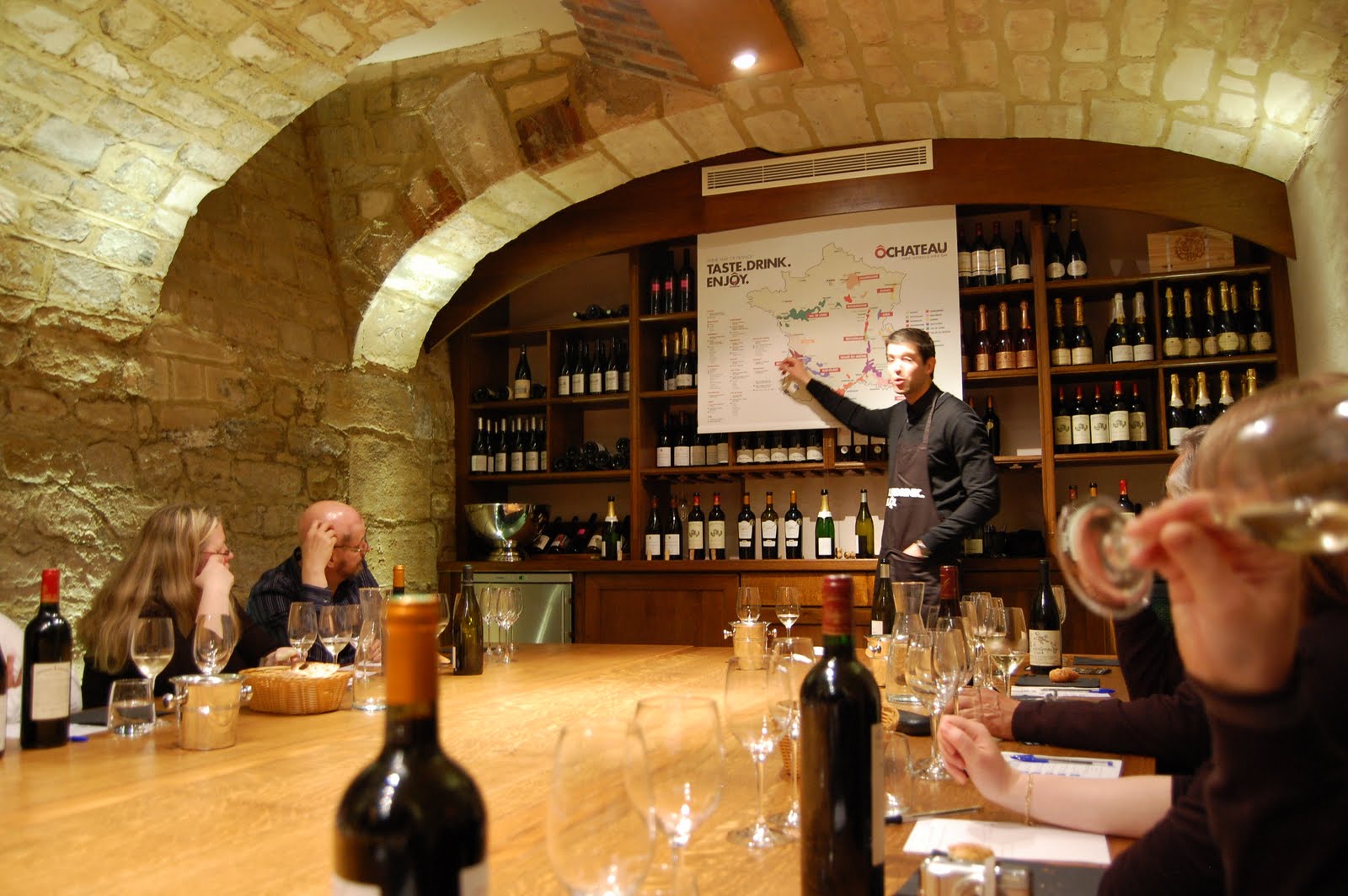
This week I went with a friend to a French wine masterclass at O Chateau, a wine bar near the Seine. Living in Paris, you can’t help but notice how important wine is to the French culture. I have been on a few tours of different wine cellars and caves during my weekend excursions, but I had yet to learn about tasting wine, ordering wine, pairing wines with food, how to read a wine label, and the different wine regions of France.
During the tasting we sampled one champagne, two white wines, and three red wines. We first learned how champagne differs from other wines. The initial step in wine-making is putting grape juice into large vats, and then adding sugar and yeast, the two elements that cause fermentation. After the fermentation process for ordinary wine, you simply bottle it and sell it. However, with champagne, you  then add more sugar and yeast into the bottle with the wine. This sugar and yeast will cause a second fermentation. With the bottle sealed, the gases stay inside and create sparkling wine, champagne.
We were taught the importance of first looking at the wine, before tasting it, checking for clarity, because wine should be clear. By looking at the brightness of the wine you learn about the acidity of the wine. The brighter the wine is, the more acidic it will taste. You can tell a wine’s age by looking at the meniscus, the ring around the top where the wine meets the glass. The meniscus on a white wine will get darker with age, while the meniscus on a red wine will get lighter with age. Finally, swirling the wine and looking at the legs/tears on the side of the glass will show the alcohol and sugar concentration. The more legs there are, the thicker they are, and the faster they go down, the sweeter your wine will taste.
My favorite part of the class was learning about the different wine regions of France. The French don’t order by the grape like we are used to doing in America, such as Pinot noir, Chardonnay, Shiraz, Merlot, etc. They order their wine according to the wine region, such as Bordeaux, Alsace, Val de Loire, Sud-Ouest, and Bourgogne, and within those larger regions are even more specific regions like Pays D’Or in Bourgogne. The French people know their wine; when they see on a menu that there is a white wine from Cote Chalonnaise, they recognize that it is a region of Bourgogne (Burgundy) that produces Chardonnay grapes, so they will know that they are ordering a Chardonnay. Out of ALL the wines we tasted, the Chardonnay was my favorite. It was wonderful to learn so much about French wine! We left the class feeling more than a little tipsy, but also much more confident about ordering and buying wine in the future.