Sunday, May 15, 2011

Brussels & European Union

“At every crossroads on the path that leads to the future,
tradition has placed 10,000 men to guard the past.” - Maurice Maeterlinck
(Belgian Symbolist Poet, Playwright, and Essayist 1862-1949)
This week I went on a class field trip to Brussels, Belgium for the day, with my European Union class, to take a tour of the European Union Parliament building and see the other EU buildings in the European Quarter of Brussels. Technically, the EU has no official capital, but Brussels is home to many of the EU institutions, including the European Commission, Council of the European Union, the European Council, and it is the second seat of the European Parliament. During our visit we took a tour of the Espace Léopold, the building which houses the European Parliament.
The EU Parliament is the only directly elected body of the EU. The Parliament is made up of 736 MEPs (Member of the European Parliament) who are elected every five years by the citizens of the 27 Member States of the European Union. Parliament is the “first institution” of the EU and shares equal legislative authority with the Council, and both have equal control over the EU budget. Parliament plays an active role in drafting legislation in areas such as environmental protection, consumer rights, equal opportunities, transport, and the free movement of workers, capital, services and goods. It was fun to see where all of the action takes place.
After our visit, we walked around Brussels, ending up in the old town area at the Grand Place. This square is the most important tourist destination in Brussels. The area was first established in the 10th century by Charles, the Duke of Lower Lorraine, and by the 11th century the marketplace was established. The City Hall was built in this square in 1409, and after that came the King’s House and the many guildhalls to surround the square. The Grand Place served as a market all the way until 1959, and it has recently been voted the most beautiful square in Europe. Going to Brussels on a field trip was amazing. I visited Bruges during my spring break, but didn’t have a chance to see Brussels. It is not as quaint and idyllic as Bruges, but it was fun to experience another large European city.

Saturday, May 14, 2011

La Cuisine Paris

 “The only real stumbling block is fear of failure.
In cooking you’ve got to have a what-the-hell attitude.”  - Julia Child

This week I took a cooking class at La Cuisine Paris near L’Hotel de Ville. I have been wanting to do this all semester, and finally got around to doing it. We learned how to make three types of popular French breakfast pastries: croissants, croissant aux amande, and pain au chocolat. I’ve never taken a cooking class before, and it was fun to meet other amature cooks like myself, who are interested in learning how to cook popular French foods.
In the class we not only learned how to make the croissant dough, but how to make fillings, and also how to roll the dough with the fillings. The head chef, Jenny, told us that you can be very creative with croissant fillings. You can play around with the types of extract you use in the cream, with vanilla, orange, almond. She says it is important to be creative, and even suggested using jam if you want fruity flavor. One of her favorite ways to make croissants is to fill them with gruyere cheese and ham for a savory breakfast.
The most complicated task of the class was making the dough for the pastries. To get the end product you have to fold together two squares; one of the dough and one of BUTTER. Combining these two to get the perfectly layered dough requires a lot of rolling and folding. You also have to be careful that the butter never gets too warm. If the dough starts to spring back or you see any shiny parts of butter you have to put it in the refrigerator to cool it down before continuing on with the rolling and folding. All of this work definitely paid off, because in the end we took away some YUMMY pastries. Learning how to make French breakfast pastries with people from all over the world in a small cooking school in Paris was an amazing experience! It will be so fun to use the skills I’ve learned to cook for my friends and family back home.

Thursday, May 5, 2011

Rethinking Stereotypes & Critical Thinking

"Travel is fatal to prejudice, bigotry, and narrow-mindedness, and many of our people need it sorely on these accounts.  Broad, wholesome, charitable views of men and things cannot be acquired by vegetating in one little corner of the earth all one's lifetime."  ~Mark Twain
While studying abroad in Paris , I have been exposed to stereotypes that the French have about Americans, as well as reminders of stereotypes that Americans back home have about the French. A few days ago I met a couple of French boys near the Pantheon who told me that they had just watched the movie, American Pie, and thought that college life in America looked like one big, crazy party. Unfortunately, this stereotype of Americans is popular with the French. I tried to explain to these guys that all American students are not like those in the movies, but I’m not sure they believed me.
For many people from other countries, the only thing they know about the United States is what they have seen on TV, and the content of some of those shows makes it understandable that they might have a warped view of America . Americans traveling  abroad can either reinforce those stereotypes, or give people a different view of Americans. I hope that the French people I have met can see that there is a flip side to the American images portrayed by TV shows like the Jersey Shore and Baywatch, and movies like American Pie. I hope they can see that we are not all alcoholic bimbos with no manners, class, or brains.
On the other hand, in America there is the stereotype that the French are mean, nasty people, who hate Americans. I can honestly say that this is NOT true. I have met so many kind, nice French people. I remember discovering this almost immediately, when on my second night in Paris , while I was buying yogurt from the corner store, the man behind the counter showed me how to hold my bag and told me to always have it zipped and in front of me, as he was concerned that I would be pick-pocketed! I find that in Paris “Bonjour” and a smile go a long way. Greetings and manners are appreciated here. Sometimes when I eat at the dining hall on campus a French person will sit near me and turn to me, smile, and wish me “bon appétit!” It’s times like those when it is hard for me to imagine why anyone would accuse the French of being nasty people. I think that your experience completely depends on the attitude you bring with you.
Before coming to France , I was told a great analogy that is used to explain the difference between French and Americans by comparing them to coconuts and peaches. Americans are peaches. They are soft on the outside, easy to get to know, friendly, and hard in the center(pit), only letting a few people know their true inner selves. The French are coconuts. They are hard on the outside, and sometimes can seem rude or brief with strangers, but they are incredibly soft on the inside. Once they make a friend they are extremely loyal and remain friends for life. In America we tend to have more surface-level friends than very close friends. When a coconut and a peach bump into each other the peach gets bruised and gets its feelings hurt, while the coconut moves on as if nothing important has happened. So there are differences between French and American people, but they are not so severe that they cannot be overcome. I like to remind myself to look for the good in people, an early lesson learned in childhood from the movie, Pollyanna:

“When you look for the bad in mankind, expecting to find it, you surely will.”
- Abraham Lincoln

Monday, May 2, 2011

Santé!

"After one taste of French food ... I was hooked. I'd never eaten like that before, I didn't know such food existed. The wonderful attention paid to each detail of the meal was incredible to me. I'd never really drunk good wine before, and knew nothing at all about it. It was simply a whole new life experience." Julia Child
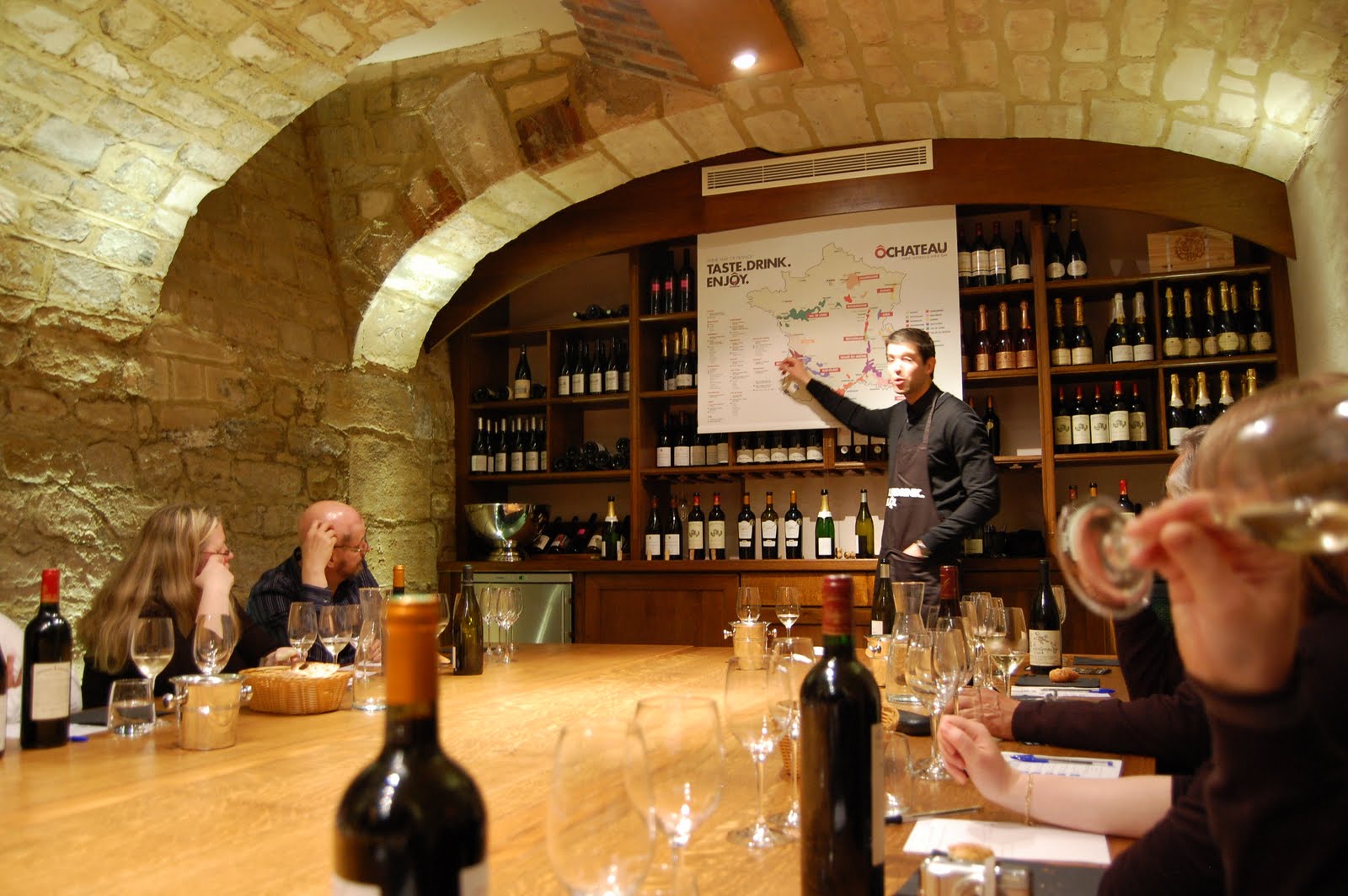
This week I went with a friend to a French wine masterclass at O Chateau, a wine bar near the Seine. Living in Paris, you can’t help but notice how important wine is to the French culture. I have been on a few tours of different wine cellars and caves during my weekend excursions, but I had yet to learn about tasting wine, ordering wine, pairing wines with food, how to read a wine label, and the different wine regions of France.
During the tasting we sampled one champagne, two white wines, and three red wines. We first learned how champagne differs from other wines. The initial step in wine-making is putting grape juice into large vats, and then adding sugar and yeast, the two elements that cause fermentation. After the fermentation process for ordinary wine, you simply bottle it and sell it. However, with champagne, you  then add more sugar and yeast into the bottle with the wine. This sugar and yeast will cause a second fermentation. With the bottle sealed, the gases stay inside and create sparkling wine, champagne.
We were taught the importance of first looking at the wine, before tasting it, checking for clarity, because wine should be clear. By looking at the brightness of the wine you learn about the acidity of the wine. The brighter the wine is, the more acidic it will taste. You can tell a wine’s age by looking at the meniscus, the ring around the top where the wine meets the glass. The meniscus on a white wine will get darker with age, while the meniscus on a red wine will get lighter with age. Finally, swirling the wine and looking at the legs/tears on the side of the glass will show the alcohol and sugar concentration. The more legs there are, the thicker they are, and the faster they go down, the sweeter your wine will taste.
My favorite part of the class was learning about the different wine regions of France. The French don’t order by the grape like we are used to doing in America, such as Pinot noir, Chardonnay, Shiraz, Merlot, etc. They order their wine according to the wine region, such as Bordeaux, Alsace, Val de Loire, Sud-Ouest, and Bourgogne, and within those larger regions are even more specific regions like Pays D’Or in Bourgogne. The French people know their wine; when they see on a menu that there is a white wine from Cote Chalonnaise, they recognize that it is a region of Bourgogne (Burgundy) that produces Chardonnay grapes, so they will know that they are ordering a Chardonnay. Out of ALL the wines we tasted, the Chardonnay was my favorite. It was wonderful to learn so much about French wine! We left the class feeling more than a little tipsy, but also much more confident about ordering and buying wine in the future. 

Friday, April 29, 2011

Spring Break Heaven

"I soon realized that no journey carries one far unless, as it extends into the world around us, it goes an equal distance into the world within." Lillian Smith


Hurray for Spring Break! I had an amazing time traveling around Europe over the last two weeks. I started off my adventure by doing a nine-day tour of Italy called “Italian Espresso,” and this summarized what the experience was: a strong, full, yet short taste of Italy. The tour kicked off in Rome where we got to skip the lines to see the Coliseum, the Roman Forum, and Vatican City. Other sites enjoyed were the Spanish Steps, Trevi Fountain, and the Pantheon. Last year I took a course at WSU called Rome: Republic & Empire and it was really special getting to see all the historical sites that I had learned about in that class. 
Leaving Rome, we headed to the Tuscany region and spent three nights in its capital, Florence. I love this city! We watched a leather making demonstration, climbed to the top of the Duomo, saw Michelangelo’s David in the Galleria dell’Accademia, and explored the markets. One day was spent in Tuscany visiting the picturesque hill town of San Gimignano and a winery known for its production of the regional specialty, chianti. On our way to Venice we made two pit stops. The first was in Pisa, where we took all sorts of funny pictures of the Leaning Tower. Next we traveled to Verona, the home of Romeo and Juliet. We visited the house of Juliet and got to see the balcony and courtyard that were key settings in Shakespeare’s play. While we were here, of course, we had to write our letters to Juliet, just like in the movie!
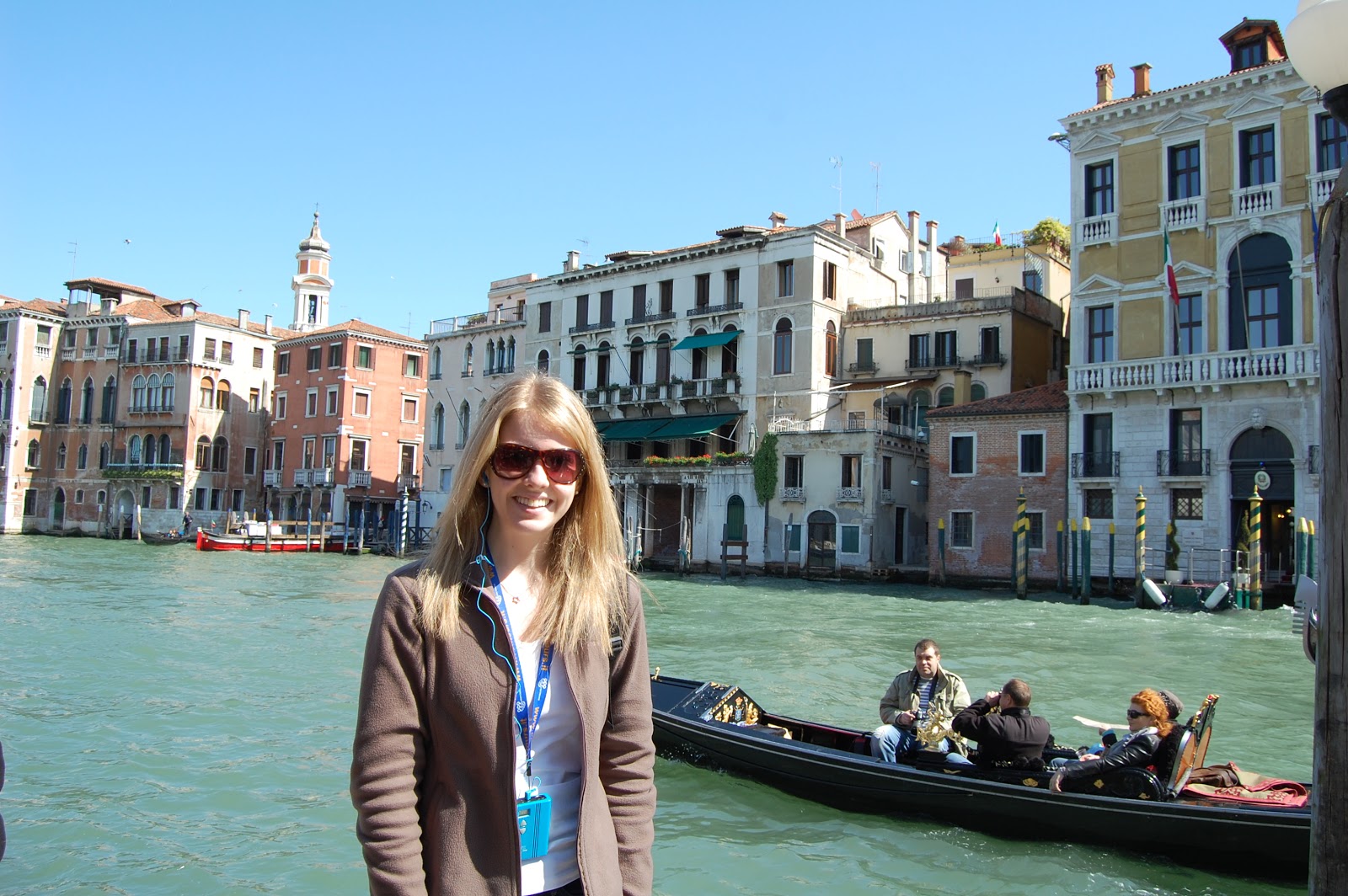
At the end of our day on the road we arrived in Venice, another wonderful Italian city. There were guided tours of St. Mark’s Square, the Rialto Bridge, and the Venice markets. On one shopping trip I bought a beautiful carnival mask. We saw a glass-making demonstration at the famous Morano glass shop, took a gondola ride through the lovely canals, and celebrated a farewell dinner on our last night together on the Grand Canal. I have special memories of the wonderful people I met on my first trip to Italy, and I hope I can see them again someday.
After my Contiki tour was over, I took a train the next morning bound for the Cinque Terre. I had heard so many people rave about these five villages; I knew that I didn’t want to leave Italy without seeing them. Even though it was a solo trip, I am VERY happy I made that decision. I spent two nights in Vernazza, by far the most idyllic of the five towns, with its natural harbor and beautiful pastel houses. I spent my time hopping from one town to the next, visiting the other four villages of Monterosso al Mare, Riomaggiore, Manarola, and Corniglia. I am in love with the Cinque Terre and if I ever win the Lotto, I know where I am moving. Haha. Many times during my short stopover there, I felt like I needed to pinch myself to make sure I wasn't dreaming, it was so beautiful. 
It was hard to leave such a tranquil, restful place like the Cinque Terre, but I was excited for my flight to England! With only a week until the royal wedding, London was buzzing. Tourists like me loved all of the Will & Kate memorabilia from the flags and mugs to the tea towels and stamps. However, the Londoners seemed less excited about it and were simply looking forward to using their four-day weekend to get out into the countryside, away from all the crowds. I signed up for an “England in One Day' tour. In just 12 short hours I traveled to Stonehenge, Bath, through the Cotswolds, and to Stratford-upon-Avon. It was a long, but amazing day. I got to see SO much of England and at one point the guide even said to us “If you look to the far right, over there you can see a bit of Wales!” One of the friends I met on my Contiki tour in Italy, Elise, lives in London. The next day I met up with her and she took me all over and showed me the highlights of the city. We saw the Tower of London and the Crown Jewels, the Tower Bridge, Westminster Abbey, Big Ben and Parliament, the River Thames, St. James Park, Buckingham Palace, Trafalgar Square, Piccadilly Circus, Hyde Park, Kensington Gardens, Kensington Palace, and Platform 9 ¾! I’m so glad I spent a few nights in London before my next tour. Being there the week before the royal wedding and experiencing all the hype was a unique experience.
Following three nights in London, it was time to depart for my next Contiki adventure, Easter in Amsterdam. Leaving London, we made our way to the White Cliffs of Dover where we caught a ferry to the French coast. From there we headed north to Amsterdam. Spending three nights in Amsterdam gave us the opportunity to see so much of the city and the surrounding area. We went on a boat cruise through the canals, toured the Red Light District, and visited the world famous Keukenhof gardens to see the beautiful tulips. There was a trip to Anne Frank’s house, the Van Gogh museum, and experiencing Amsterdam’s amazing nightlife. During this tour we also ventured outside of the city to Volendam, a town on the coast, and to Edam where we rode bikes by windmills and saw cheesemaking and clogmaking demonstrations. The Netherlands is a special place where I felt like I belonged. The happy, friendly, casual, liberal people reminded me a lot of the Pacific Northwest. Birkenstocks, boats, fishing.....It felt like home.
On Easter Monday it was time for me to return to Paris, but to delay the end to my epic journey, I decided to hop a few trains to Bruges, Belgium for the day. This city has been on a list of places I wanted to see before the end of the semester, and I am so happy that I was able to add this stop to my vacation. Bruges is an idyllic Belgian town with its canals, churches, and cute, picturesque houses. I made sure to indulge in the local specialties of waffles, chocolate, and beer; there is nothing like drinking a beer in Bruges that was made in Bruges! It was very relaxing to walk through this town. There are no huge, major sites that attract buses of tourists. I simply wandered through the city and took in the sights as they came. The boat tour through the canals was the highlight of the day, along with shopping for handmade lace. Getting from Bruges back to Paris was quick and easy, with only one transfer in Brussels, then taking the high speed Thalys train to Paris in a mere hour and fifteen minutes! I found train-hopping from one city to the next to be a wonderful experience. I definitely prefer trains to planes, because not only do you get to see more of the countryside and meet more people, but you also don’t have to go through security worrying about liquids or baggage restrictions. Whether traveling alone, or traveling with a group, I learned so much on this Spring Break, both about the world and about myself. It was an experience I will never forget. 
*    Too many pictures for one blog. See my Facebook for more.

Saturday, April 9, 2011

Cross-Cultural Learning & Integration

“If you reject the food, ignore the customs, fear the religion, and avoid the people, you might better stay home.” – James Michener

The average tourist passing through Paris could probably quickly see the sights, ignore the customs, and offend the French people without even realizing it. However, if you want to live here for an extended period of time and try to fit into the culture, it helps to learn to adapt to new ideas and ways of thinking.
·         France is a country of manners and etiquette. Upon entering any store or small shop you need to say “Bonjour Madame/Monsieur.” This is a sign of respect and not doing this is like a slap in the face.
·         When I eat at cafes or restaurants I can’t help but notice the particular table manners the French have. It’s polite to always keep your hands above the table and not in your lap. I have yet to see a Frenchman eat a hamburger with their hands. The French insist on using a knife and a fork when they eat a hamburger, and they do the same for fries! When you eat bread at dinner, the bread rests on the table, not on your plate. Also when dining out, never expect to have a drink served with ice. 
·         The first few times I took the metro I was amazed at how quiet it was. On the metro the French keep to themselves, avoid eye contact, and don’t talk. The metro is a haven for gypsy pickpockets, so to protect yourself you should always hold your bag tightly in front of you. If you want to stand out as an American and make yourself a target, all you have to do is act loud, talkative, and giggly and believe, me you’ll be noticed.
·         One way to help yourself fit into the French culture is to adjust your fashion style. To avoid the American tourist look, don’t wear white athletic shoes or shorts. In Paris you can never go wrong wearing black, no matter what time of year it is. An easy way to look très chic is by simply adding a scarf to your outfit; scarves are very French.
·         Even shopping for groceries in France is a different experience. Don't plan on grocery shopping on a Sunday, because almost all of them are closed; I know of only one that remains open on Sundays. There are NO baggers at French grocery stores, so be prepared to bag all of your groceries at the check-out.
·         Going to a public bathroom is different as well. Don’t be surprised if there is a fee to use the restroom. I don’t think that I’ve ever had to pay more than fifty cents. Some would say that’s ridiculous, but when you gotta go, you gotta go. Besides, the bathrooms that charge are usually maintained by a nice attendant and are very clean. If we had that in the U.S. we would not only be creating jobs, but we would also have pristine public restrooms. Also, when it comes to bathrooms, don’t expect to find paper towels after you wash your hands. It’s a rare occasion to see them; most of the time there are only hand-drying machines.
·         Unlike the parks in the U.S., in most of the parks in Paris it is NOT okay to walk on or sit on the grass; you must use the chairs and benches.The only two places I know of where you can sit on the grass are the Champs de Mars in front of the Eiffel Tower and Parc Montsouris in the 14th arrondissement.
·         In general, the French are more relaxed and enjoy a slower pace, taking time to enjoy the little pleasures in life. Americans are always in such a hurry, just take a look at a McDonald’s drive thru. One of my professors was shocked to hear that it is extremely common in America to eat in your car. She thought that sounded absurd, and when you think about it from a French point of view, it really does sound rather strange. In France the people take their time, enjoying long lunches in the afternoon. When they sit down for dinner in a restaurant, they don't rush through the meal, because once you get your table, it’s considered yours for the night. The service reflects this idea. Don’t be in a hurry; it can sometimes take more than 30 minutes to get your check.

So if you want avoid the label of the annoying, ignorant, arrogant American….follow the tips above, and remember that old saying, “When in Rome , do as the Romans do.” Hey, I'm going to Rome TOMORROW! My Spring Break starts today, so I won't be blogging for a while....Au revoir!

Wednesday, April 6, 2011

Once Upon a Time...

"Life itself is the most wonderful fairy tale of all." – Hans Christian Andersen
This weekend I went on an overnight trip to the Loire Valley with other students in my study abroad program. The Loire Valley is southwest of Paris, and it took us about three hours by bus to get to our destination to see beautiful châteaux! There are more than 300 châteaux in the Loire Valley, which, in my opinion, makes it one of the most wonderful places in France. My favorite kinds of books to read are historical fiction novels. Walking through these châteaux, I couldn’t help but wonder what it would have been like to live there or visit on a weekend hunting trip with French kings and nobility from long ago. 
 On our first day we traveled to the Château de Chenonceau, which was built on top of the River Cher. The chateau that remains today was built in 1515 under Thomas Bohier, the Chamberlain for King Charles VIII of France, but eventually the château was taken over by King Francis I of France. The castle was then passed down to Henry II, who scandalously left it to his mistress Diane de Poitiers after his death. The Queen, Catherine de’ Medici, was not happy about this, and forced Diane to exchange Chenonceau for another chateau. This was Catherine’s favorite home and she cared for it with great detail. Later that day we took a tour of the famous mushroom caves of Bourré, one of the last places in the world that grows mushrooms in a natural underground environment. Because of the farming methods used, these mushrooms have an incomparable flavor, with a high vitamin content. 
 On Saturday we were lucky to enjoy beautiful, 70-degree weather. It felt amazing! Unfortunately, our good luck wore off and Sunday was cold and rainy, but being from the Pacific Northwest, I’m always prepared for the rain. The first chateau we went to that day was Château d’Amboise, a favorite of the French kings. King Francis I was raised here, and he invited Leonardo da Vinci to Amboise to stay in a nearby mansion. Francis I was able to visit da Vinci whenever he pleased by using a secret, 500-meter long tunnel. In addition, King Henry II and Catherine de’ Medici decided to raise their children here at Amboise. For me, the coolest thing to see here is the tomb of Leonardo da Vinci inside St. Hubert Chapel.
 The highlight of my day was a trek through the rain with a few of my friends to Close Lucé. This is the mansion that Leonardo da Vinci moved into in 1516, where he spent the last three years of his life. Da Vinci brought three paintings with him to the Chateau de Cloux: the Mona Lisa, Saint Anne, and Saint John the Baptiste. While living here, da Vinci worked on his paintings and his invention designs. A large display in the basement holds forty models of the various machines and devices that da Vinci designed in his journals. Leonardo’s ideas were way beyond his time. Many of his models would not actually have been feasible, but in 2006, Italy’s Institute and Museum of the History of Science in Florence built a working model of Leonardo’s idea for a self-propelled car and surprisingly, it worked! After being thoroughly impressed by Leonardo’s genius, and then buying some gourmet chocolates in town, it was time to leave Amboise to visit one last château, the Château de Chambord.
 Chambord is the most recognizable chateaux in the world because of its size, and the distinct French Renaissance architecture. This is the castle that served as the inspiration for the Beast’s home in Disney’s Beauty and the Beast. It was built for King Francois I to be used as hunting lodge, but he only really spent seven weeks here total. Even though the chateau felt rather empty and cold, there were some beautifully decorated bedchambers and studies. The architectural highlight on the inside is, without a doubt, the double-helix staircase designed by da Vinci. He invented a spiral staircase that makes it so that a person going up the stairs will never cross paths with a person who is going down the stairs....a mind-boggling idea! Visiting this chateaux made me feel like Cinderella, and it was the perfect end to my fairytale weekend in the Loire Valley.